Arash Vaezi
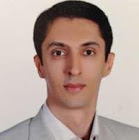
Researcher
Algorithms · Distributed Systems · Computational Geometry
-
Research Interests
My research focuses on the design of algorithmic systems with provable guarantees, particularly in:
- Distributed and decentralized algorithmic systems
- Approximation algorithms and geometric optimization
- Computational geometry (visibility, covering, and guarding problems)
- Randomized and derandomized algorithmic techniques
- Algorithmic Branding
-
A SELECTION OF PUBLICATIONS
1- Geometric Set Cover Beyond Simple Objects.
Arash Vaezi, Alireza Zarei
We study geometric set cover under a general structural assumption: for every subset of objects, the induced arrangement has polynomially many cells. Unlike most previous approaches, our framework does not rely on assumptions such as linear union or bounded-complexity objects. We present a randomized LP-based algorithm combining object replication, thresholding, and a quasi-uniform sampling process with iterative heavy/light decomposition. Under the above assumption, the algorithm achieves a near-constant approximation ratio of in expectation. We also show how to derandomize the framework in polynomial time using conditional expectations. As an application, the framework yields a near-constant approximation algorithm for vertex guarding simple polygons with n vertices, improving the best-known approximation ratio for this problem. This problem was open for decades.
2 – Discretizing Segment Visibility: Optimal Guarding under Bounded Diameter Ratio.
Arash Vaezi, Alireza Zarei
The bounded diameter ratio (AR), a purely geometric parameter that captures the intrinsic width imbalance of a polygon relative to inter-segment visibility, was previously introduced by one of our previous papers. We show that AR precisely characterizes the discretizability of segment-to-segment and segment-to-region visibility. Under the condition that AR = poly(n), we have an algorithm that selects a finite set of guards on a source segment whose visibility polygons cover a target segment. We proved that the condition is necessary and the algorithm provides optimal results. We extend this result to weak visibility polygons, and we show that one can achieve, within a constant approximation factor, the optimal set of guards on a given source segment to cover the weak visibility of the source.
3- The Loop of the Rings: A Fully Decentralized Reliable Cooperative System.
Arash Vaezi, Amir Daneshgar, Arshia Dadras, Kasra Siavashpour
We introduce LoR, a reliable, scalable, fully decentralized, and distributed cooperative system, where LoR stands for “Loop of the Rings”. Distinct from conventional transaction-oriented systems, LoR handles cooperation using its ring-based randomized structure, making it suitable as both a cooperative workspace and a versatile platform for service provisioning, accommodating various roles such as freelancers, IoT management systems, and even 5G-related services. In LoR users access a reliable environment, enabling them to either share in or offer a predetermined set of services initially determined by an admin. LoR may also be implemented as a middleware that operates independent of the underlying infrastructure. Assuming a proportion of at least $60$ percent of honest participants in an instance of LoR, the system provides reliability, scalability and user satisfaction i.e. users may make occasional mistakes or face temporary issues such as network delays, yet those who act correctly will ultimately be satisfied by receiving their services or payments. In fact, we prove that users of LoR will be satisfied whatever happens in the system unless they are malicious. In addition to introducing LoR’s structure along with its operating rules in detail as our main contribution, we also provide mathematical analysis for the worst-case scenarios as well as a typical minimal real-case simulation supporting our theoretical results on LoR’s reliability, scalability and user satisfaction.
4- FAIR: An Envy-Free Multi-Agent Model for Traffic Systems.
Arash Vaezi, Sepideh Niknejad, Arshia Dadras, Kasra Siavashpour
We introduce FAIR (Fairness-Aware Incremental Routing), a dynamic multi-agent traffic system that enforces fairness in routing decisions while continuously adapting to real-time congestion. Agents move through a shared directed road network and repeatedly recompute shortest paths at intersections using density-aware edge weights derived from a non-linear car-following model. The system evolves through a sequence of discrete decision states, each encoding agent positions, local densities, and traversal costs, enabling agents to make informed, myopic routing decisions in a fully dynamic environment. We prove that the FAIR routing decisions select edges that incur the smallest incremental delay rather than the currently fastest path which leads to congestion-efficiency.
5- Near-Constant Approximations for the Point-Guarding Problem.
Arash Vaezi, Alireza Zarei
Given a simple polygon P, the Art Gallery Problem (AGP) asks for the minimum number of guards that see all of P. In the point guarding variant, guards may be placed anywhere inside or on the boundary of P. The problem is NP-hard and APX-hard, ruling out exact polynomial-time algorithms and PTASes unless P = NP. For simple polygons, the best-known polynomial-time algorithms (as of the writing of this document) achieve an O(log(|OPT|)) approximation for point guarding P. This result, however, rely on structural assumptions on P (e.g., integer coordinates and general position). We present an approach that provides a 3.2^{O(log* n)}.|OPT| approximation factor for the problem, where n is the number of vertices of P under the bounded width ratio (the ratio of the diameter divided by the minimum width of P). This assumption is proven to be necessary.
6- Visibility extension via reflection.
Arash Vaezi, Bodhayan Roy, Mohammad Ghodsi
This paper studies a variant of the Art Gallery problem in which the “walls” can be replaced by reflecting edges, allowing the guards to see further and thereby see a larger portion of the gallery. Lee and Aggarwal already proved that several versions of the general Art Gallery problem are NP-hard. We also know that the problem is APX-hard, ruling out polynomial-time algorithms and PTASes unless P = NP. We show that several cases of adding an area to the visible area of a given point guard by reflection are also NP-hard. However, we prove that assuming all edges are reflectors, one can decrease the minimum number of guards required to cover the whole gallery by an arbitrary amount by setting a parameter.
7- Agent-Cells with DNA Programming: A New Concept.
Arash Vaezi
-
Education
School of Computer Sciences
PostDoc Researcher, Sharif University of Technology
Department of Mathematical Science
Supervisor: Dr. Alireza Zarei
Ph.D. in Computer Science and Engineering [Algorithm],
Department of Computer Engineering, Sharif University of Technology.
Supervisor: Prof. Mohammad Ghodsi
Best Ph.D. Student Award
M.Sc. in Computer Science and Engineering [Algorithm],
Department of Computer Engineering, Sharif University of Technology.
Supervisor: Prof. Mohammad Ghodsi
Advisor: Dr. Mohammad Ali Abam
-
TEACHING EXPERIENCE
Five years of experience teaching courses required for the Computer Science and Engineering entrance exams (MSc and Ph.D.).
(Courses: Operating System, Data Structure, Designing Algorithms, Discrete Mathematics, Automata Theory), before 2020.
Sharif University of Technology:
Course Name: Data Structured and Algorithms, Course Number: 40254, 2020.
Sharif University of Technology:
Course Name: Massive Data (Streaming Data), Course Number: 40686, 2023.
Sharif University of Technology:
Course Name: Operating Systems, Course Number: 22861, 2024.
-
A FEW PROFESSIONAL EXPERIENCE
Designing Large-Scaled Software (LoR).
Designing a Decentralized system to manage telecommunication systems (Agent Cells) A monitoring system beneficial to move from 4G to 5G, Fakour corporation.
Designing a Job Leveling infrastructure for Mofid Institute.
Designing a Learning infrastructure for Mofid Institute.
Designing a universal management system for the Copper Mine of Sarcheshmeh, Rafsenjan. Manager: Mr. Rafsenjani. USPS project on MESS of Sarcheshmeh (Mr. rafsanjani_mo@nicico.com)
Designing a driving culture for Iran. Submitted to the Department of motor vehicle (DMV) . Under the supervision of Mr. Sarhang Nejad Heydari
Consulting and System designer in CFP corporation.
Consulting and System designer in Amn Gostar corporation.
Discovering miRNAs, Stable in Serum also Present in Tumors, which are Special in Detecting Breast Cancer. A project related to early detection of breast cancer, under the supervision of Dr. Sharifi and Royan Institute
Designing an ibt platform to be replaced by the traditional entrance exam, Sanjesh organization, Dr. Asaraie
-
A FEW HONORS
Winner of the Gold statue of the best graduated Ph.D. Student of the Department of Computer Science and Engineering, Sharif University of Technology.
I had a Dean’s Fellowship admission from NYU, Supervisor: Prof. Boris Aronov,
NYU Email=av1585@nyu.edu.
I had a GTA admission From Ohio State University, Supervisor: Prof. Tamal Dey.
Ranked 3rd Ph.D. National Entrance Exam (computer engineering-software).
Ranked 2nd Among 50 students in Computer Engineering Department, Undergraduate Studies.
Certificate of Attendance, Workshop conducted by Springer and Edanz.
Signed by: Dr. Warren Raye, Dr. Mohammad R. Moahhedy, Dr. Chris Bendall.
Certificate of Attendance and Presentation.
JGA, Computational Geometry.
Signed by: Dr. Mathien Carriere, Dr. Kristof Huszar, Dr. Clement Maria.
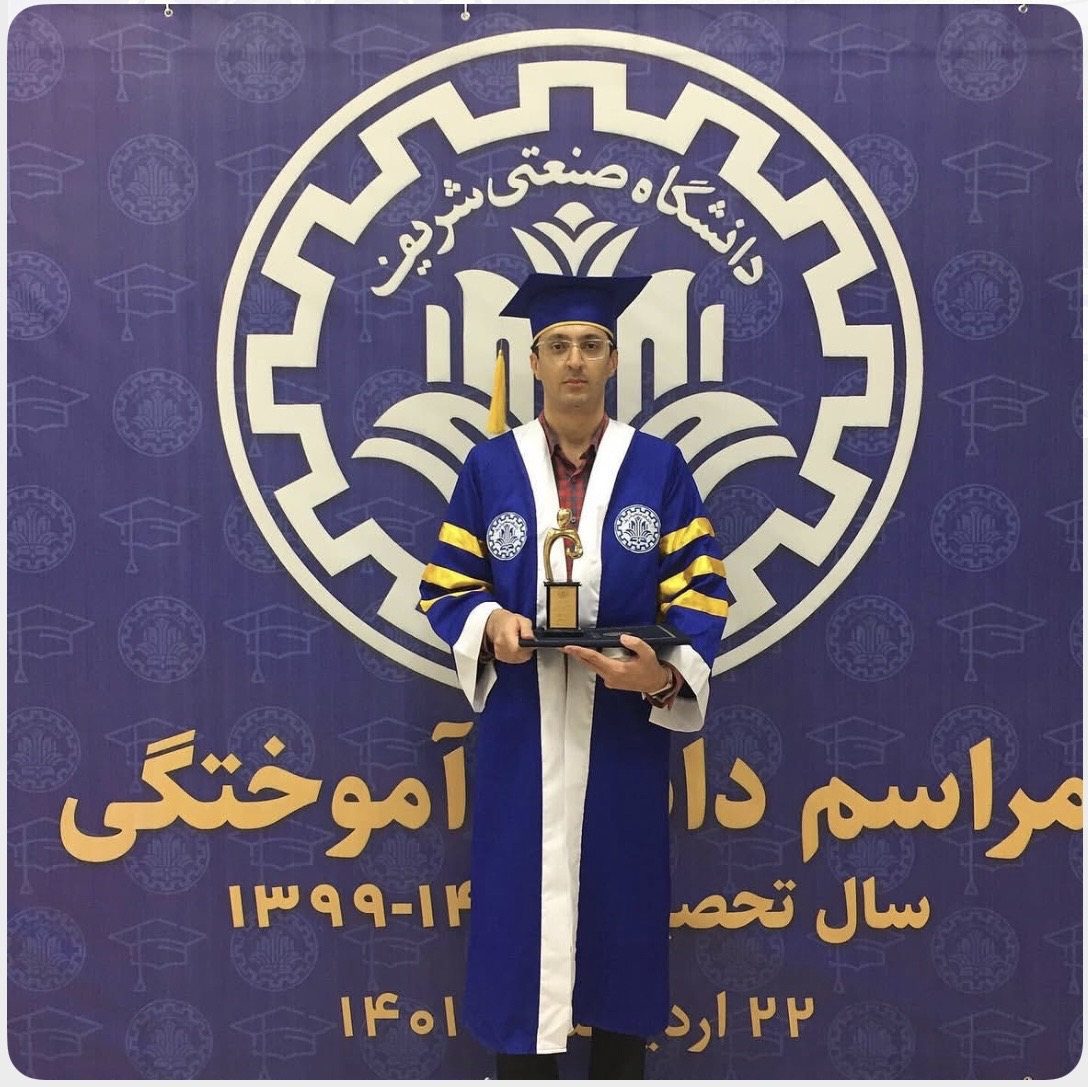
Golden Statue Award for the Best PhD Student of Sharif University of Technology
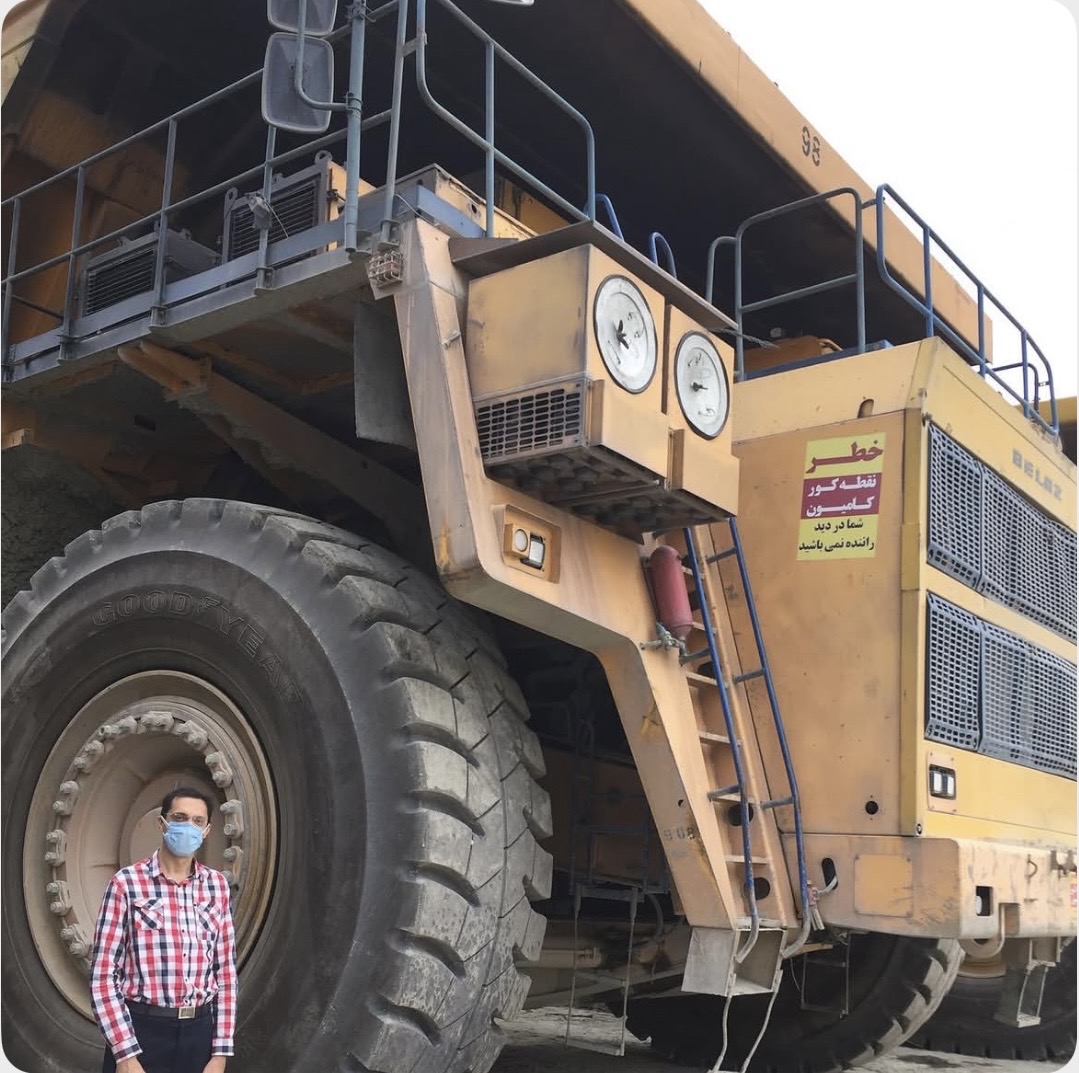
The USPS project in the copper mine
TAAK
Arash’s experience designing decentralized and intelligent systems made him an incredible designer. In 2018 he designed a nice decentralized distributed system called LoR that provides a reliable environment for everybody to collaborate with others worldwide. There are many highly advanced algorithms designed in the platform provided by LoR. LoR stands for “the Loop of the Rings” which points out the structure of the system. TAAK corporation is an implementation of the LoR system.